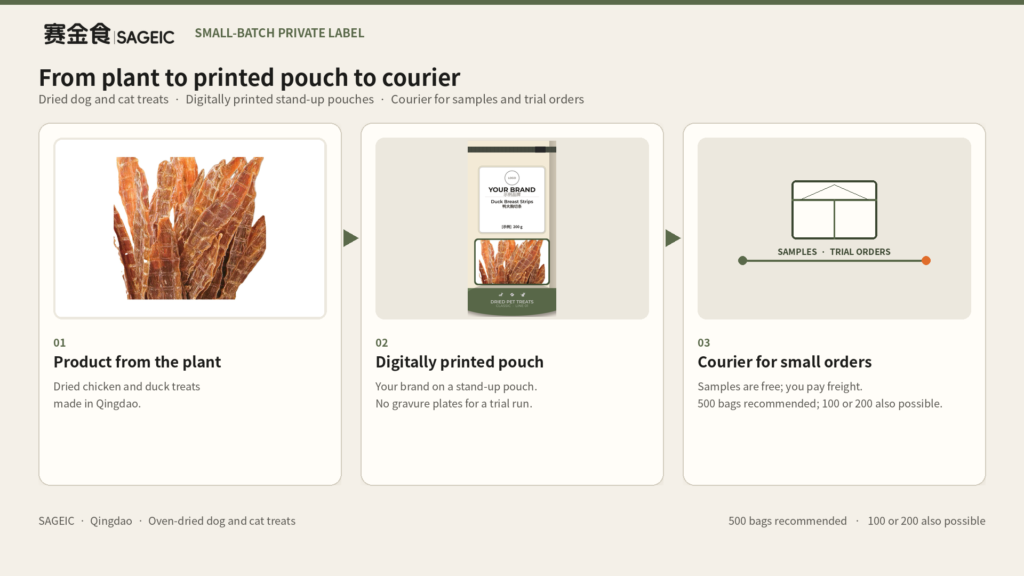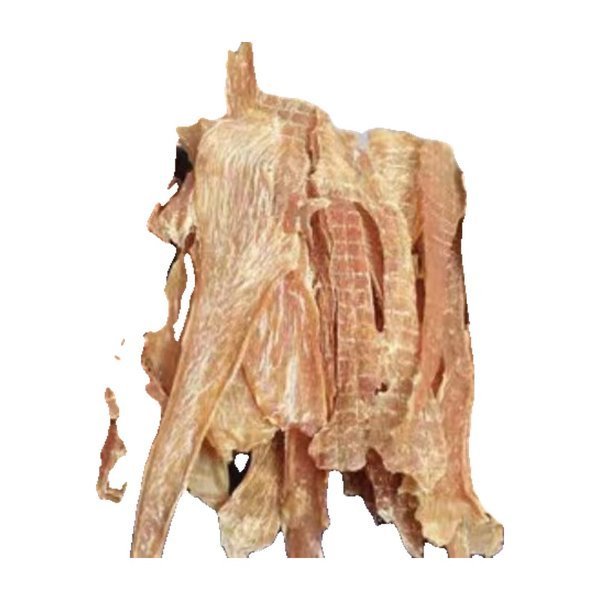
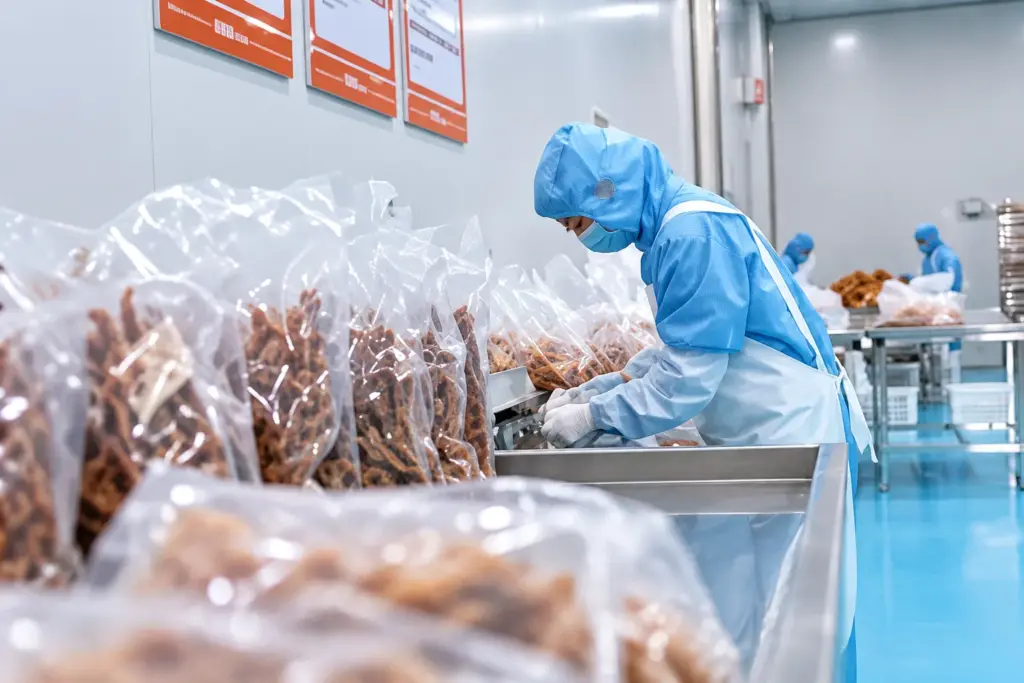
A pet treat specification sheet turns an approved sample into a written reference for purchasing, production and incoming inspection. It should identify the exact product, its agreed characteristics, the pack configuration and the evidence needed to accept a shipment. For a private label brand, this helps answer a practical question: will the next order match the product we approved?
At SAGEIC, pet treats have no product minimum order quantity. A small trial order and a later repeat order still need a clear specification. Custom-printed bags may have a separate minimum print run and setup costs, which we confirm for the chosen packaging. This guide explains what buyers of dried pet treats should put in their specification before placing a repeat order.

What belongs in a pet treat specification sheet?
Use one controlled document for each product and pack configuration. A catalogue helps you shortlist products; a specification records what both parties have agreed to supply and accept. Start with the fields below, then ask the factory to confirm achievable limits and the supporting documents for the selected SKU.
| Field | What to record | Why it matters |
|---|---|---|
| Product identity | Supplier SKU, buyer code, product name and revision date | Prevents a similar product from being substituted accidentally. |
| Recipe and process | Approved ingredient declaration and agreed processing description | Keeps purchasing, artwork and production aligned. |
| Physical characteristics | Length, thickness, piece weight, appearance and texture criteria where relevant | Makes sample comparisons repeatable. |
| Analysis and testing | Agreed parameters, limits, methods, test frequency and required reports | Clarifies which results support acceptance. |
| Retail pack | Net quantity, pouch specification, seal, artwork version and lot/date code | Identifies the complete saleable item. |
| Master carton | Packs per carton, dimensions, weights and carton markings | Supports receiving and freight planning. |
| Approval record | Reference sample, approved revision and change authorisation | Defines which version applies to the order. |
1. Link the SKU to an approved sample
Record the supplier’s SKU and your own item code together. Add the sample lot or reference number, approval date and photographs. For a wrapped treat, identify both the outer meat and the core; a name such as “wrapped chew” leaves too much open to interpretation.
Keep agreed reference samples on both sides where practical. Physical samples change during storage, so record their condition and agree when to replace them. Photos help describe shape and colour, but they cannot establish composition or microbiological results. Our dog treat samples guide covers the initial evaluation process.
2. Describe measurable characteristics
“Same quality as last time” is difficult to inspect. Replace it with relevant measurements and an agreed way to assess them. For sliced treats, discuss thickness and piece-size variation. For wrapped products, describe acceptable wrapping coverage and exposed core. For fragile formats, agree how broken pieces will be defined and assessed.
Distinguish a target from an acceptance limit. A nominal length describes the intended product; an agreed range describes what the buyer will accept. Also decide how many pieces or packs to inspect and how to record the result. Do not copy tolerances from another SKU without checking that they suit the selected product and process.
3. Separate typical analysis from agreed limits
A typical value in a catalogue, a result from one sample and an agreed specification limit serve different purposes. Ask which values apply to the chosen SKU, how they were established and which are supported by current reports. Record units and the reporting basis so that results can be compared consistently.
List the tests required for the project, the acceptance criteria, the test method or laboratory arrangement and whether results are needed for each lot or at another agreed frequency. Where a certificate of analysis is requested, clarify which tests it will report and how it will identify the lot. A generic report from a different product is not evidence for the lot being supplied.
Confirm shelf life and storage wording for the actual product and packaging combination. If either changes, ask whether the supporting assessment needs to be updated. Discuss product-specific documents with the factory and confirm destination requirements with the importer before approving the final specification.
4. Specify the pack as carefully as the treat
Record the net quantity, pouch dimensions and material specification, closure, approved artwork file and code placement. Include bags per carton, carton dimensions and the agreed carton markings. If the quotation includes additional packaging features, name them explicitly instead of assuming they apply to every product.
Check a filled pack before approval. Product shape affects how a pouch sits, how the seal area stays clear and how the pack fits inside a carton. A change from one retail pack size to another should therefore trigger a review of both the pouch and the carton. See our private label pet treat packaging guide for plain, labelled and custom-printed options.
5. Agree what happens when something changes
Give the specification a revision number and date, and quote that revision on the purchase order. Agree which changes require written approval before production, such as a recipe adjustment, a different pack material, a revised net quantity or new artwork. Record the change, the reason, any new sample or testing needed, and the first order to which it applies.
A repeat order should reference the approved revision rather than an informal message saying “same as before.” If a buyer accepts a one-off deviation, document its scope and the affected lot. Decide separately whether the permanent specification should change.
A practical repeat-order check
- Confirm the SKU, pack size, order quantity and specification revision.
- Confirm whether the recipe, product characteristics, packaging or artwork has changed.
- Agree required reports, inspection records and the timing of their review.
- Check the production and dispatch schedule for this order.
- At receiving, record carton condition, lot codes and results against the agreed criteria.
If a delivery differs from the agreed specification, identify the affected lots and document the issue with measurements and photographs. Contact the supplier with those records before mixing the stock with other lots. This gives both parties a useful basis for investigating the difference and agreeing the next step.
Frequently asked questions
Is a product catalogue enough for a repeat order?
A catalogue supports product selection. A repeat order should also identify the agreed specification, pack configuration and approved revision. Ask the factory to confirm any information that the catalogue does not provide.
Can one specification cover several pack sizes?
The product requirements may be shared, but each pack size needs a clearly identified packaging configuration. Keep the net quantity, artwork, pouch and carton information traceable to the item being ordered.
Do small trial orders need a specification?
Yes. Even a short agreed specification creates a reference for later orders. SAGEIC has no minimum order quantity for the product itself; custom-printed packaging minimums and charges are confirmed separately.
Discuss your product specification with SAGEIC
Send the SKU or product format, destination market, preferred pack size, order quantity and any existing specification. We can review the information for the selected product and identify details that need confirmation before quoting. Explore our pet treat range and OEM and private label service, email sales@sageicpet.com, or contact us on WhatsApp: +86 17669606473.