Buying cat treats wholesale means sourcing smaller, softer, more meat-forward pieces than a typical dog range, then proving to a picky animal and a cautious retailer that they are worth reordering. The formats that work best for cats are freeze-dried single-protein bites, soft chicken slices and sausage rounds, torn chicken breast, and small duck-wrapped treats such as egg yolk. This guide covers how cat buyers differ from dog buyers, the six formats worth considering, the specs to write down, and how to run a private label project with a factory.
Key takeaways
- Cats are obligate carnivores and selective eaters, so cat ranges lean on high animal-protein recipes, strong meat aroma and small, soft pieces.
- Treats are complementary products, not complete diets. Nutrients such as taurine matter in complete cat food. A treat label should say it is for intermittent or supplemental feeding and give a modest daily amount.
- Six formats cover most cat lines: freeze-dried bites, soft sausage slices, air-dried chicken slices, torn chicken fillets, duck-wrapped egg yolk and duck-wrapped vegetables.
- Specify piece size, moisture, water activity, micro limits and pack size in writing. Cat treats sell in small packs, so pieces per pack matters more than kilos per carton.
- Vet suppliers on certificate scope, China Customs (GACC) export registration and per-lot lab testing, not on photos.
In this guide
How Cat Treat Buyers Differ from Dog Treat Buyers
Production lines for dogs and cats overlap, but the buying logic does not. Four differences shape almost every cat SKU.
- Smaller pieces. A cat takes a treat in one or two bites and rarely gnaws on a long chew. Pieces that work for a medium dog need to be cut, torn or formed much smaller.
- Animal protein first. Cats are obligate carnivores. Owners and retailers expect meat as the first ingredient and are wary of high-starch or heavily plant-based recipes.
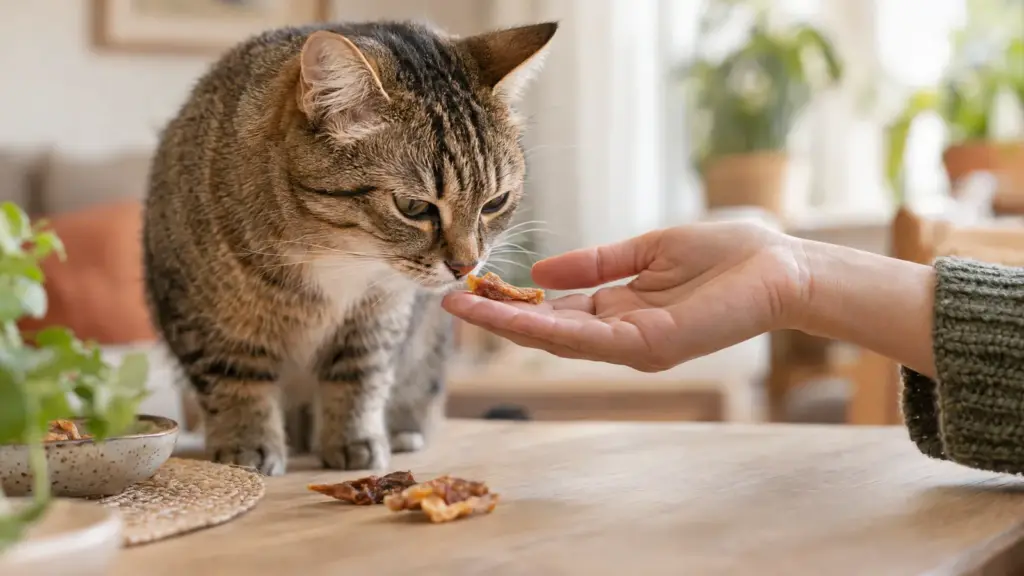
- Palatability is the deciding test. A cat that refuses a treat once may never try it again, and the owner will not reorder. Aroma, texture and freshness after opening count for more than in a dog line.
- Smaller packs, higher price per gram. A cat eats only a few pieces a day, so retail packs are smaller and the shelf price per kilo is higher.
Nutrition claims need care. Taurine is an essential nutrient for cats, but the requirement applies to the complete diet. A treat is fed in small amounts next to a complete food, so it is not expected to meet the full cat nutrient profile. Do not call a treat “complete and balanced” unless it has been formulated and substantiated as such. A common guideline is to keep treats to around 10% of daily calories, and that belongs in your feeding guidance.
Cat Treats Wholesale: 6 Formats That Work
These six formats cover most private label cat treats on the market, and most can share raw material with a dog range.
1. Freeze-dried single-protein bites
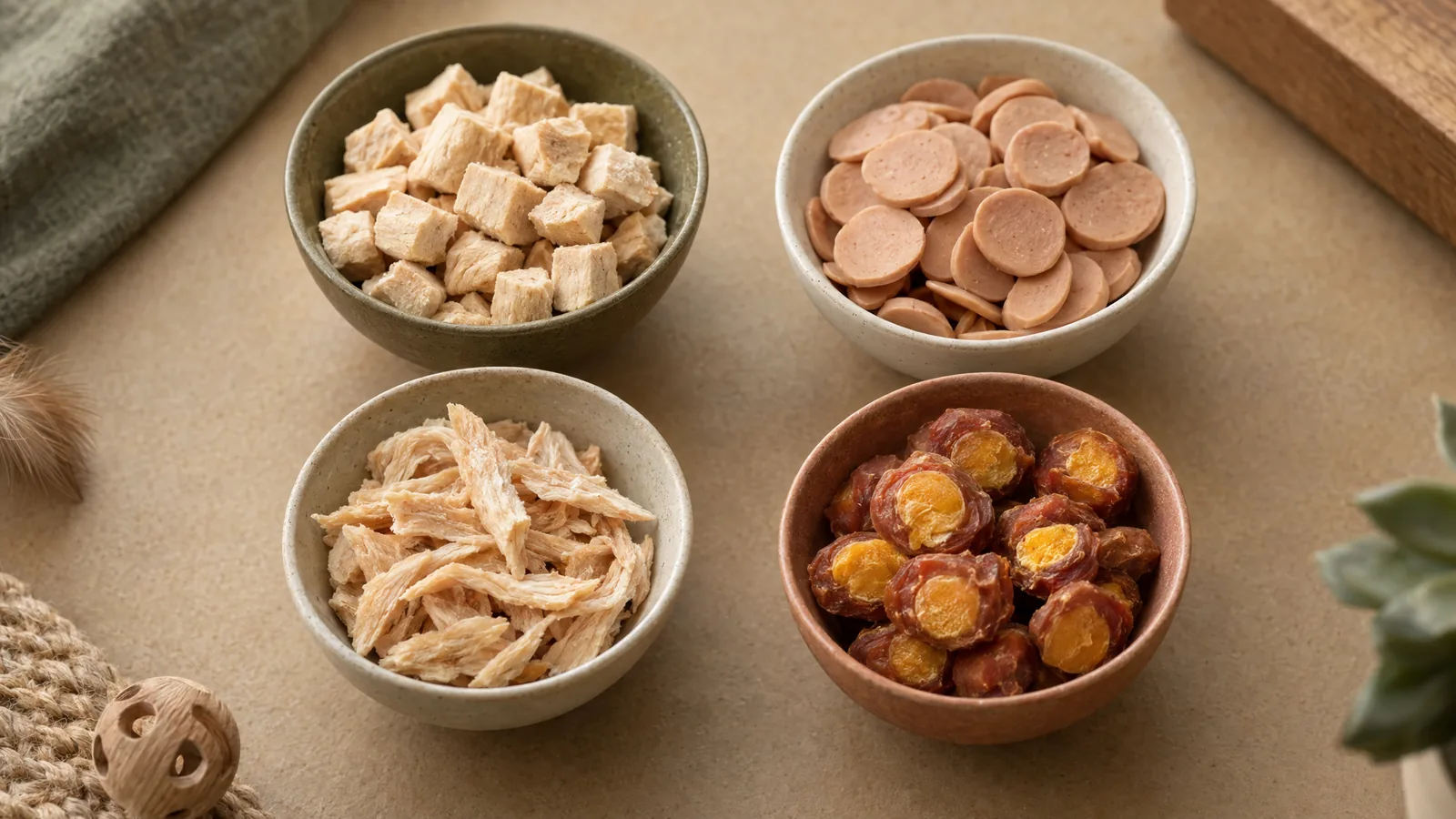
Freeze-dried treats are cubes or nuggets of a single meat or fish, dried under vacuum at low temperature. They are light, crumble easily, keep a strong aroma and suit “single ingredient” positioning. Freeze-dried cat treats also work as a food topper, which gives owners a second reason to buy. The trade-offs are cost per kilo (the process is slow and the product is light) and fragility in transit. Ask for broken-piece limits and use rigid jars or padded pouches.
2. Soft sausage slices
Meat is emulsified, formed into a sausage and sliced into thin rounds. The texture is soft with no hard pieces, which suits kittens, seniors and cats with weak teeth. Chicken Sausage Slices are a good example: chicken breast 78%, potato starch 17%, glycerin 4% and a vitamin and mineral premix 1%, with crude protein of at least 36% and moisture of at most 22%. The starch is what makes the even round shape possible, so declare it plainly rather than marketing the slices as starch-free.
3. Air-dried chicken slices
Thin slices of chicken breast, dried at low temperature, sometimes with a small functional ingredient. Flaxseed Chicken Slices are 94% chicken breast with 3% flaxseed and guarantee at least 43% crude protein. Chicken Cucumber Slices press chicken breast (70%) with cucumber (27%) into a lighter slice at about 33% protein. Slices tear easily into cat-sized pieces.
4. Torn whole chicken fillets
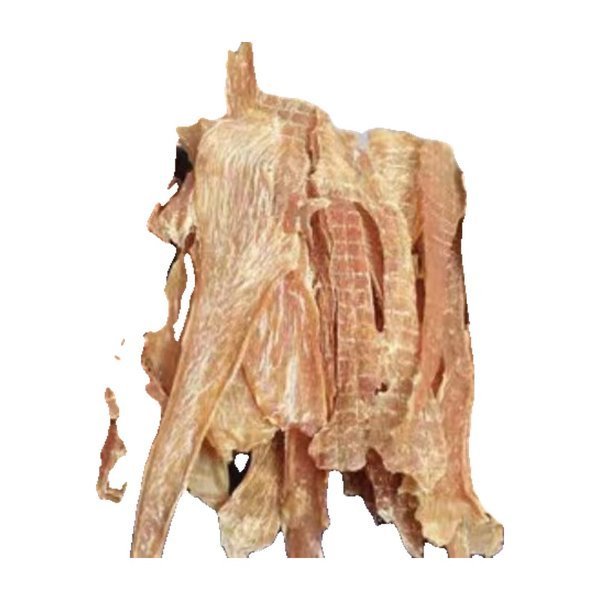
Whole raw-cut chicken breast, dried in one piece and torn into portions by the owner. Mushroom Chicken Breast Fillets (96% chicken breast, 2% reishi mushroom powder) reach at least 44% crude protein with moisture of at most 20%. For a cat line, ask the factory to cut the fillet into smaller pieces before drying, or sell a “tear and share” pack with clear portion guidance.
5. Duck-wrapped egg yolk
A whole egg yolk wrapped in duck breast and air-dried. The round shape is easy for a cat to hold, and the yolk adds richness. Duck-Wrapped Egg Yolk is 60% duck breast and 37% egg yolk, with at least 38% protein and 8% fat. Fat is higher than in plain chicken, which helps aroma, so keep the daily amount modest on the label.
6. Duck-wrapped vegetables
Duck breast wound around a small vegetable core such as okra. Duck-Wrapped Okra is 60% duck breast and 37% okra, around 30% protein and up to 10% fiber. Many cats will eat the meat and leave the core, so test acceptance before you commit volume.
Format Comparison for Private Label Cat Treats
Analysis figures come from real product specifications. Freeze-dried figures vary by recipe, so confirm them on the spec sheet.
| Format | Texture | Typical use | Spec notes |
|---|---|---|---|
| Freeze-dried single-protein bites | Light, crumbly, airy | Reward, food topper, “single ingredient” line | Low moisture; set broken-piece limit; rigid jar or padded pouch |
| Soft sausage slices | Soft, even, no hard pieces | Kittens, seniors, daily reward | Protein ≥ 36%, moisture ≤ 22%; contains potato starch and premix |
| Air-dried chicken slices | Pliable, thin, tears easily | Daily reward, dog/cat cross-over SKU | Protein 33–43% depending on add-in; moisture ≤ 20–22% |
| Torn whole chicken fillets | Chewy, visible grain | Premium single-protein reward | Protein ≥ 44%, moisture ≤ 20%; cut small for cats |
| Duck-wrapped egg yolk | Chewy outside, dense center | Occasional rich treat | Protein ≥ 38%, fat ≥ 8%, moisture ≤ 21% |
| Duck-wrapped vegetables | Chewy meat, softer core | Cross-over meat-and-veg treat | Protein ≥ 30%, fiber ≤ 10%; test cat acceptance of the core |
Piece Size, Texture and Spec Sheet
Wholesale cat treats fail most often on physical specs rather than on lab results. Freeze-dried cubes that turn to powder draw complaints even when the analysis is perfect. Write these points into a one-page spec both sides sign:
- Piece size and count: length, width and thickness tolerances, plus pieces per gram or per pack. Cat owners count pieces, not grams.
- Texture: soft, pliable or crumbly, backed by a retained reference sample from the approved batch.
- Guaranteed analysis: protein minimum, fat minimum, fiber and ash maximum, moisture maximum, matching what goes on the pack.
- Water activity: agree on a maximum and the test method. Soft treats rely on humectants such as glycerin to stay pliable at a safe water activity.
- Microbiology: Salmonella negative per lot, plus any other limits your market expects, with lab name and method.
- Ingredient rules: no onion or garlic (both are toxic to cats), no added salt if that is your positioning, and every humectant declared.
- Broken pieces and dust: a maximum percentage by weight, especially for freeze-dried and thin slices.
Packaging for Cat Treats
Cat treats sell in small formats. Typical choices are small stand-up pouches with a zip, PET jars for freeze-dried bites, display boxes for counter sales, and bulk cartons for repackers. Because a cat eats only a few pieces a day, one pack stays open for weeks. A strong reseal and an oxygen barrier matter more than in a fast-moving dog pack.
For soft-dried meat, nitrogen flushing plus an oxygen absorber protects color and aroma. In that setup, 18 months unopened in cool, dry storage is realistic, and the products above carry a 30-day use-within guidance once opened. Printed pouches usually have a minimum print run set by the printer, so plan pouch quantities even when the treat order itself is small.
Labeling Basics for Cat Treats
Cat treat labels follow the same structure as dog treat labels: product name, species, net quantity, guaranteed analysis, ingredient list in descending order by weight, manufacturer or distributor details, and feeding directions. Our guide to pet treat label requirements walks through each panel.
Cat-specific points to check:
- State clearly that the product is for cats (or for cats and dogs).
- Give feeding directions by cat weight in pieces per day, and add a line such as “for intermittent or supplemental feeding only” when the product is not a complete diet.
- Keep claims factual. “Supports urinary health” or “for cats with allergies” can be read as health or drug claims.
- Check calorie content rules for your market. Many US states follow the AAFCO label guidance, but always confirm the current official requirements before you print.
Private Label Process and Lead Times
A private label cat treat project follows the same steps as a dog line, with more time spent on palatability testing:
- Brief: target market, formats, protein, piece size, pack type and price tier.
- Samples: the factory adjusts an existing recipe or builds a new one. Run a cat acceptance test at home or with a panel before you approve.
- Spec and artwork: sign the spec sheet and finalize label artwork against your market’s rules.
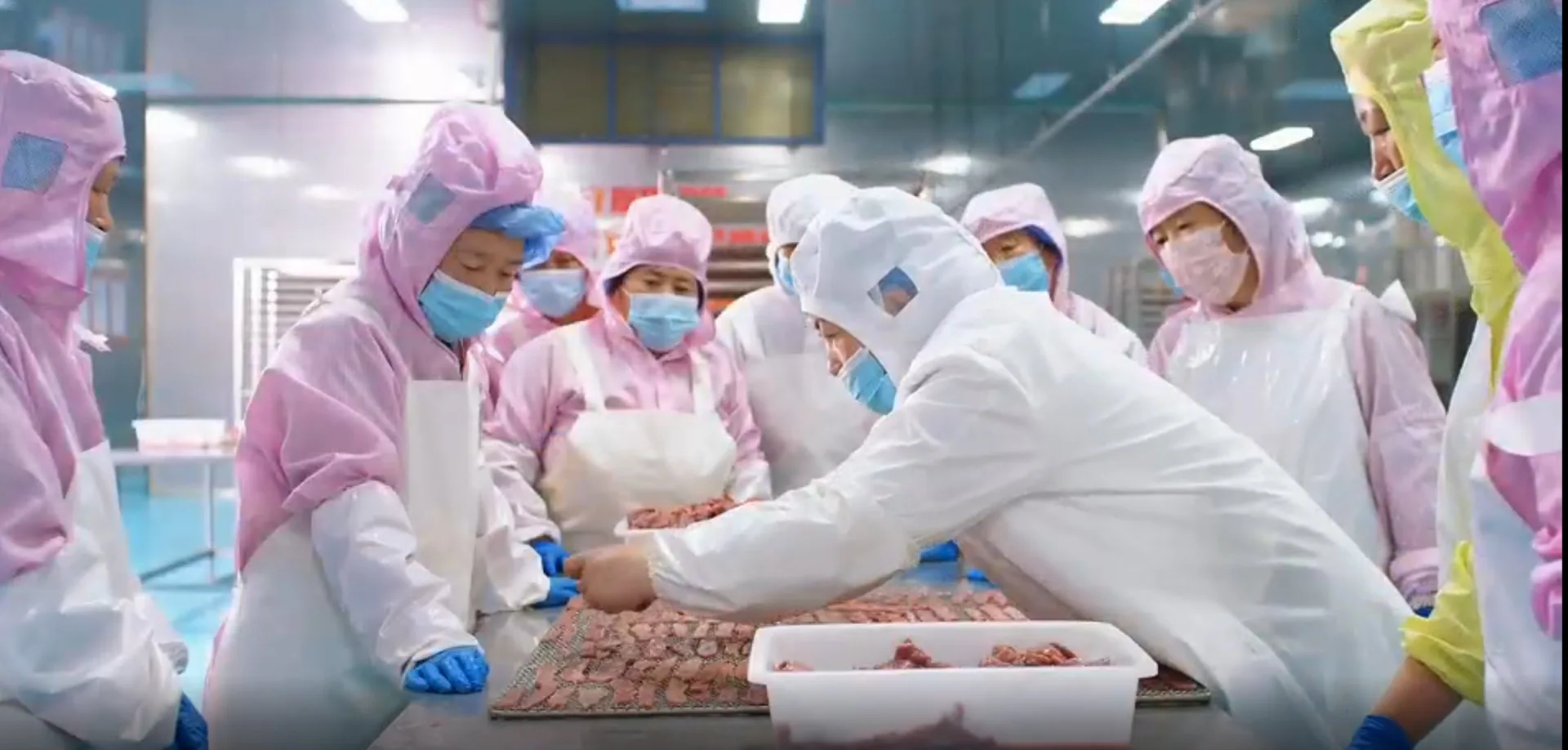
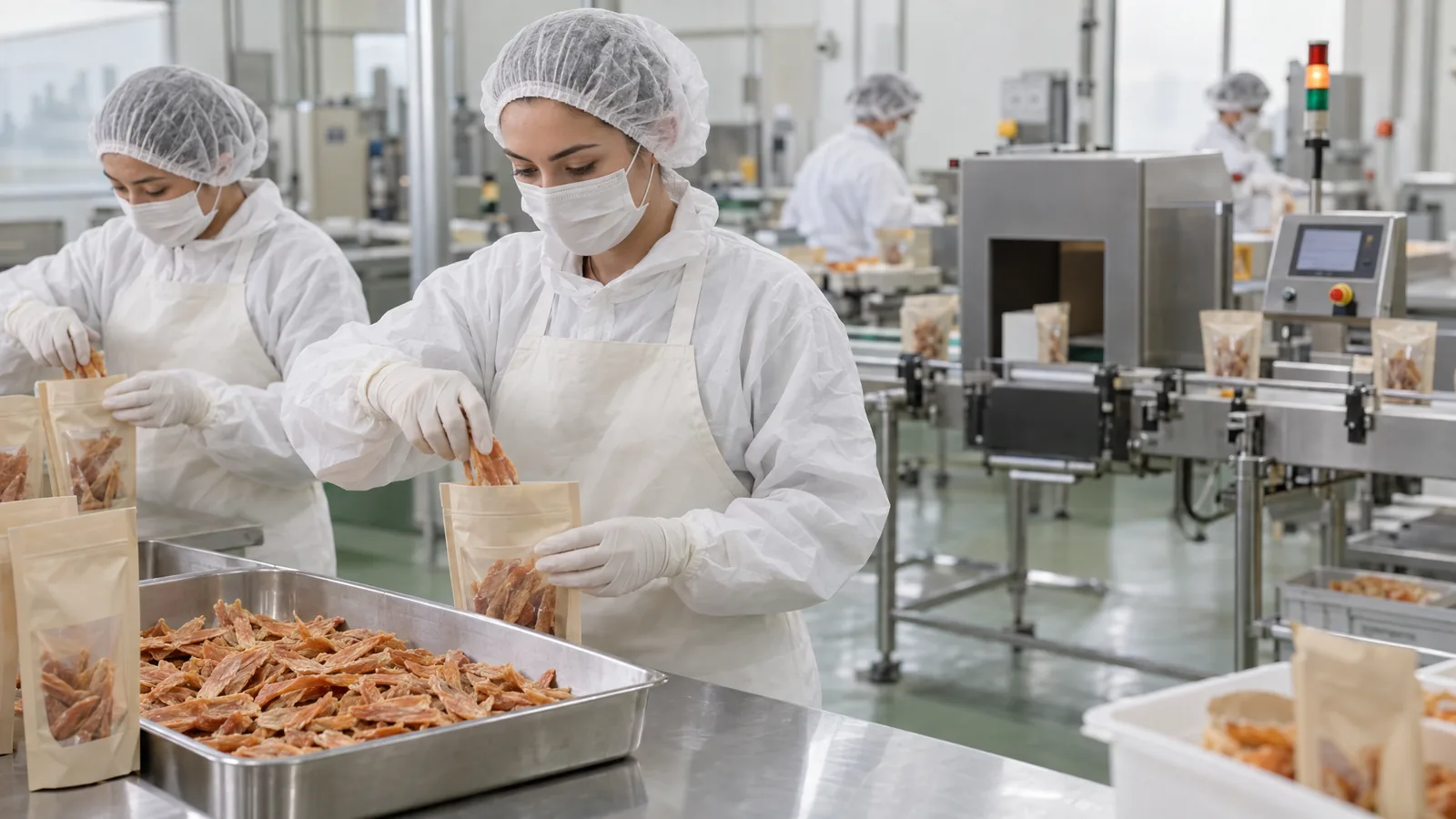
- Production and QC: per-lot testing, metal detection and retained samples.
- Shipping: FOB Qingdao or CIF, with the export documents your importer needs.
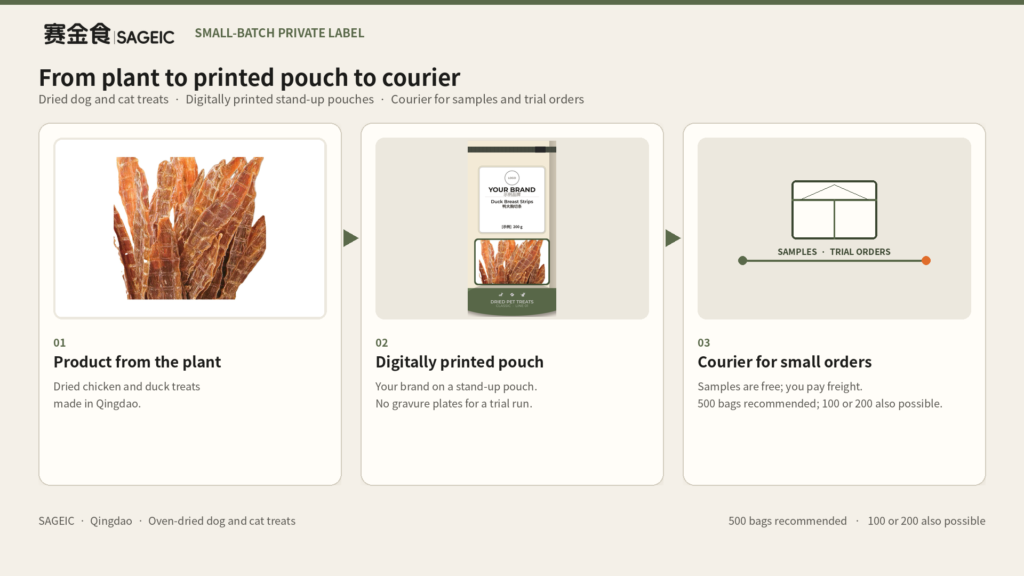
SAGEIC has no minimum order quantity, so a brand can trial a cat line with a small run of each format before scaling. Smaller runs carry a higher unit price. Samples take 2–3 weeks, and mass production takes 30–45 days after artwork approval. Our OEM and ODM page explains how projects run from brief to shipment.
How to Vet a Cat Treat Manufacturer
A cat treat manufacturer should be able to show evidence for each of these points, not just say yes:
- Food-safety certification and scope. Check a GFSI-benchmarked certificate such as BRCGS in the public directory, and read the scope line to see which products and processes were audited.
- Export registration. A Chinese plant exporting pet treats should be registered with China Customs (GACC) for export of feed products. Ask for the certificate number and registered product type.
- Lab testing. In-house tests for moisture, protein, fat and microbiology, plus third-party testing on request.
At our Qingdao plant, SAGEIC holds BRCGS Food Safety Issue 9 (Grade B, certificate 0244974, valid to May 11, 2027), ISO 9001, ISO 22000 and HACCP, and China Customs (GACC) export registration 4266PF0157 for dried pet treats. Moisture, protein, fat and microbiology are tested in-house, and SGS or Intertek testing is available on request. Details and certificate translations are on our quality page.
Start with three or four formats from the table, test them on real cats, and lock specs before you scale. That is how cat treats wholesale becomes repeat business rather than a one-off order.
FAQ
What is the minimum order for private label cat treats?
SAGEIC has no minimum order quantity for private label cat treats, so you can start with a trial run of any size. Unit prices are higher on small runs, and printed pouches usually have a minimum print run set by the printer. Samples take 2–3 weeks, and mass production 30–45 days after artwork approval.
Do cat treats need to contain taurine?
No, cat treats are not generally required to meet the full cat nutrient profile, including taurine, because they are complementary products. Taurine is essential in a complete cat diet. A treat label should make clear it is for intermittent or supplemental feeding, and treats should stay a small share of daily calories.
What size should cat treat pieces be?
Cat treat pieces should be small enough for a cat to take in one or two bites, and soft or easy to tear. Define length, width, thickness and pieces per pack on your spec sheet, and keep a retained reference sample, because size complaints are among the most common for cat lines.
Can the same treats be sold for dogs and cats?
Yes, many dried chicken and duck treats are suitable for both dogs and cats when the recipe avoids ingredients harmful to cats and the pieces are small. The label must name both species and give separate feeding guidance. Slices, sausage rounds and duck-wrapped egg yolk work well as cross-over SKUs.
How many cat treats can a cat eat per day?
A common guideline is to keep treats to around 10% of a cat’s daily calories, which usually means only a few small pieces. The exact number depends on piece weight and calorie content, so your feeding directions should state pieces per day by cat weight rather than a general amount.
What shelf life do wholesale cat treats have?
Dried cat treats in sealed, nitrogen-flushed packs with an oxygen absorber typically carry an 18-month shelf life when stored cool and dry. After opening, use within about 30 days. A good zip reseal matters for cat packs, because one pouch stays open for weeks.
Are freeze-dried cat treats better than air-dried?
Neither is better in every case; they suit different positions. Freeze-dried cat treats are light, crumbly and work as toppers, but cost more per kilo and break more easily. Air-dried slices and fillets are chewier, more robust in transit, and usually cheaper per piece.
Build your cat treat line
Tell us your market, formats and pack sizes. We’ll send spec sheets for our cat-suitable chicken and duck treats, suggest freeze-dried and soft options to fill the range, and ship a mixed sample box so you can test palatability before your first order.