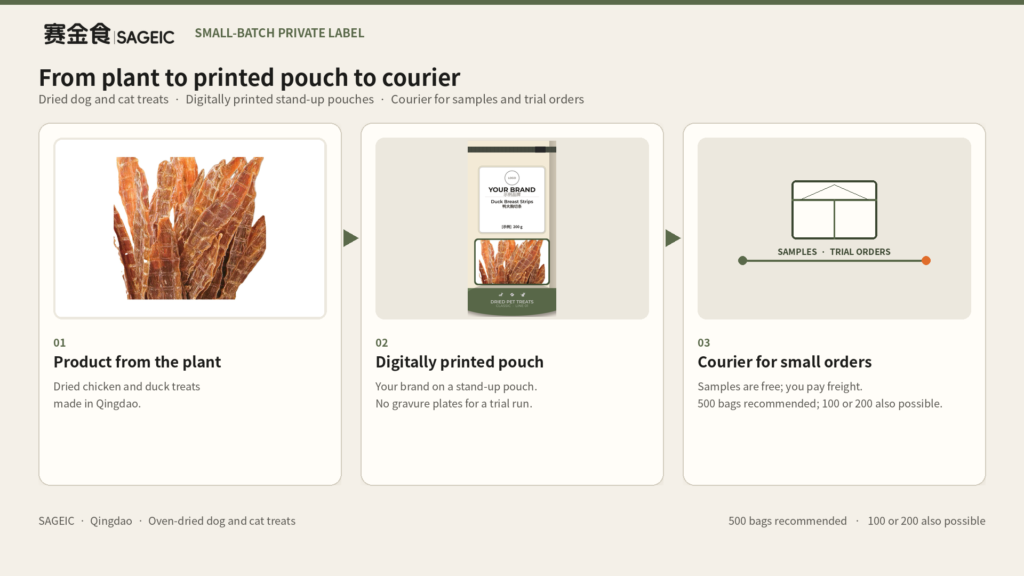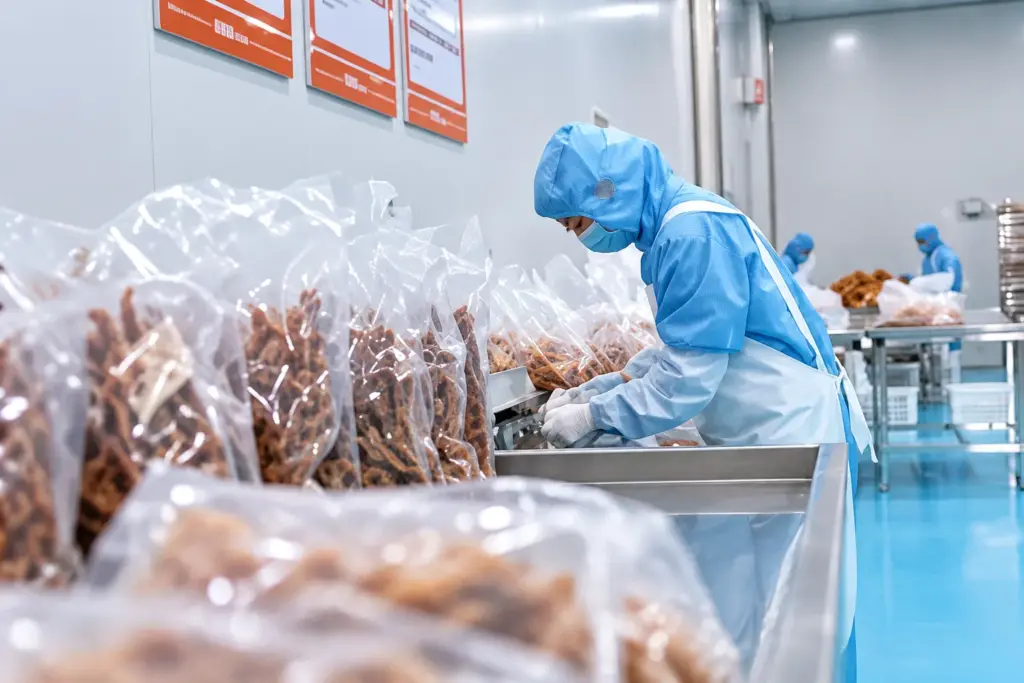
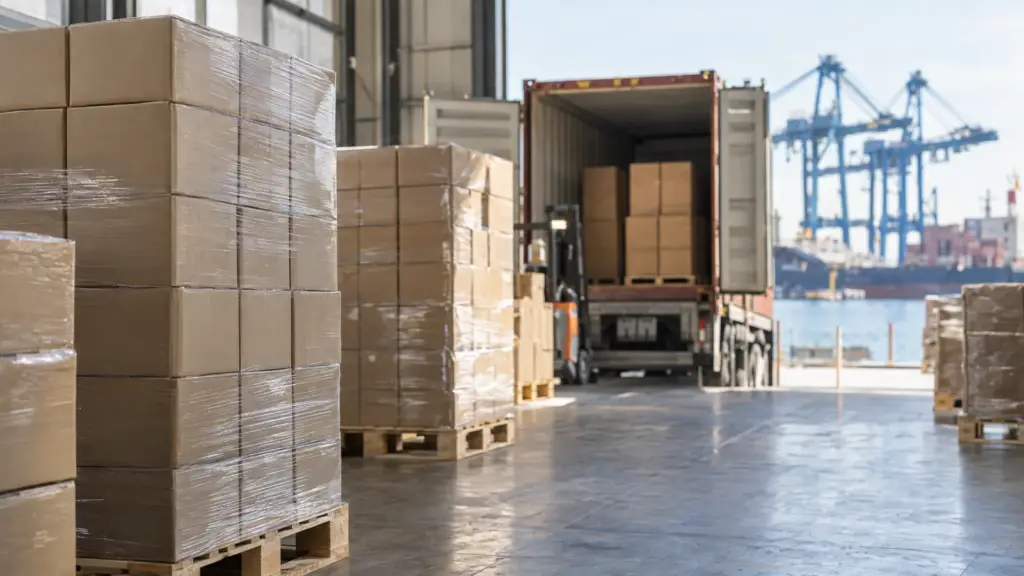
Shipping dog treats from China works best when you agree the Incoterm first (usually FOB Qingdao or CIF), let the factory handle export inspection and customs clearance at the origin port, and line up your customs broker for the destination before the container sails. The paperwork matters as much as the freight: a commercial invoice, packing list, bill of lading, certificate of origin, an official health certificate where your market requires one, and test reports for each lot.
Key takeaways
- Under FOB and CIF, risk passes to the buyer once the goods are loaded on board at the port of shipment. CIF only shifts who pays freight and minimum insurance, not who carries the risk at sea.
- DDP puts import clearance on the seller, which rarely suits regulated pet food where the importer has its own legal duties.
- Dried treats are sensitive to moisture. Good inner packaging, sturdy cartons and container desiccants prevent most condensation damage.
- Pet food export documents vary by destination. Confirm the list with your customs broker and the official authority before the first order.
- Plan the timeline backward: 2–3 weeks for samples, 30–45 days of production after artwork approval, then booking, clearance and transit.
In this guide
FOB vs CIF vs DDP: Who Pays, Who Carries the Risk
Incoterms are the ICC’s standard trade terms. They define where the seller’s delivery obligation ends, who books and pays the main freight, who arranges insurance, and the exact point where risk of loss or damage moves from seller to buyer. They do not decide when ownership passes or how payment works; your sales contract and payment terms (T/T or L/C) handle that. Always name the version and the place, for example “FOB Qingdao, Incoterms 2020,” so there is no argument later. The official rules are published by the International Chamber of Commerce.
The FOB vs CIF question confuses a lot of first-time importers because the two terms share the same risk point. In both, the seller clears the goods for export and delivers them on board the vessel at the port of shipment. From that moment, damage at sea is the buyer’s problem. The difference is cost and control: under CIF the seller also contracts and pays the ocean freight and minimum insurance to your destination port.
| Term | Seller arranges and pays | Buyer arranges and pays | Risk transfers | Best for |
|---|---|---|---|---|
| FOB (named port of shipment, e.g. Qingdao) | Export packing, inland haulage to port, export customs clearance, loading on board | Ocean freight, insurance, destination port charges, import clearance, duties | When goods are on board the vessel at the origin port | Importers with their own forwarder and freight contracts who want control of routing and cost |
| CIF (named port of destination) | Everything under FOB plus ocean freight and minimum cargo insurance to the destination port | Destination charges not covered by the freight contract, import clearance, duties, inland delivery | Same as FOB: on board at the origin port | Smaller or newer importers who want one landed-at-port price and less freight admin |
| DDP (named place of destination) | All transport, insurance choices, export and import clearance, duties and taxes to the named place | Unloading at the named place | At the named destination, ready for unloading | Simple, unregulated goods; rarely practical for pet food |
Three practical notes. First, CIF requires only minimum insurance cover (Institute Cargo Clauses C), so many buyers ask for broader cover or buy their own. Second, the ICC itself points out that FOB fits goods loaded directly on board; for containers handed to a carrier at a terminal, FCA is the technically cleaner term, and some buyers switch to it. Third, DDP means the seller acts as importer of record. For pet treats, that collides with obligations the importer must carry itself, such as FDA’s Foreign Supplier Verification Program in the US. That is why most treat factories, SAGEIC included, quote FOB Qingdao or CIF rather than DDP.
LCL vs FCL for Container Shipping Pet Treats
LCL (less than container load) means your pallets share a container with other shippers’ cargo. FCL (full container load) means you book the whole 20-foot or 40-foot box. LCL is the natural choice for trial orders and first launches, and since SAGEIC has no minimum order quantity, many new brands start this way. The trade-off is handling: LCL cargo is unloaded and reloaded at consolidation warehouses, which adds touches, time and exposure.
FCL is sealed at the factory or the origin depot and not opened again until customs or the consignee does it. For container shipping pet treats, that reduces contamination, odor transfer from other cargo, and moisture exposure. It is usually cheaper per unit once your volume is meaningful. Ask your forwarder for both quotes at your actual cubic meters; the break-even point moves with rates, and it is worth checking each season rather than relying on a rule of thumb.
- Choose LCL when you are testing a market, shipping mixed SKUs in small quantities, or need stock quickly and cannot wait to fill a box.
- Choose FCL when your order fills most of a container, you ship regularly, or the product is sensitive to odors and handling.
- Avoid mixing treats with chemicals, fragrances or other strong-smelling goods in LCL, and tell your forwarder the cargo is pet food.
Packing Dried Treats for Ocean Freight
Dried meat treats are shelf stable, but they still react to moisture and heat. The first line of defense is the retail pack. Stand-up pouches, zipper bags and PET jars can be nitrogen flushed with an oxygen absorber added, which supports an 18-month shelf life when the packaging is intact. Bulk cartons for repacking need a food-grade liner bag that is properly sealed.
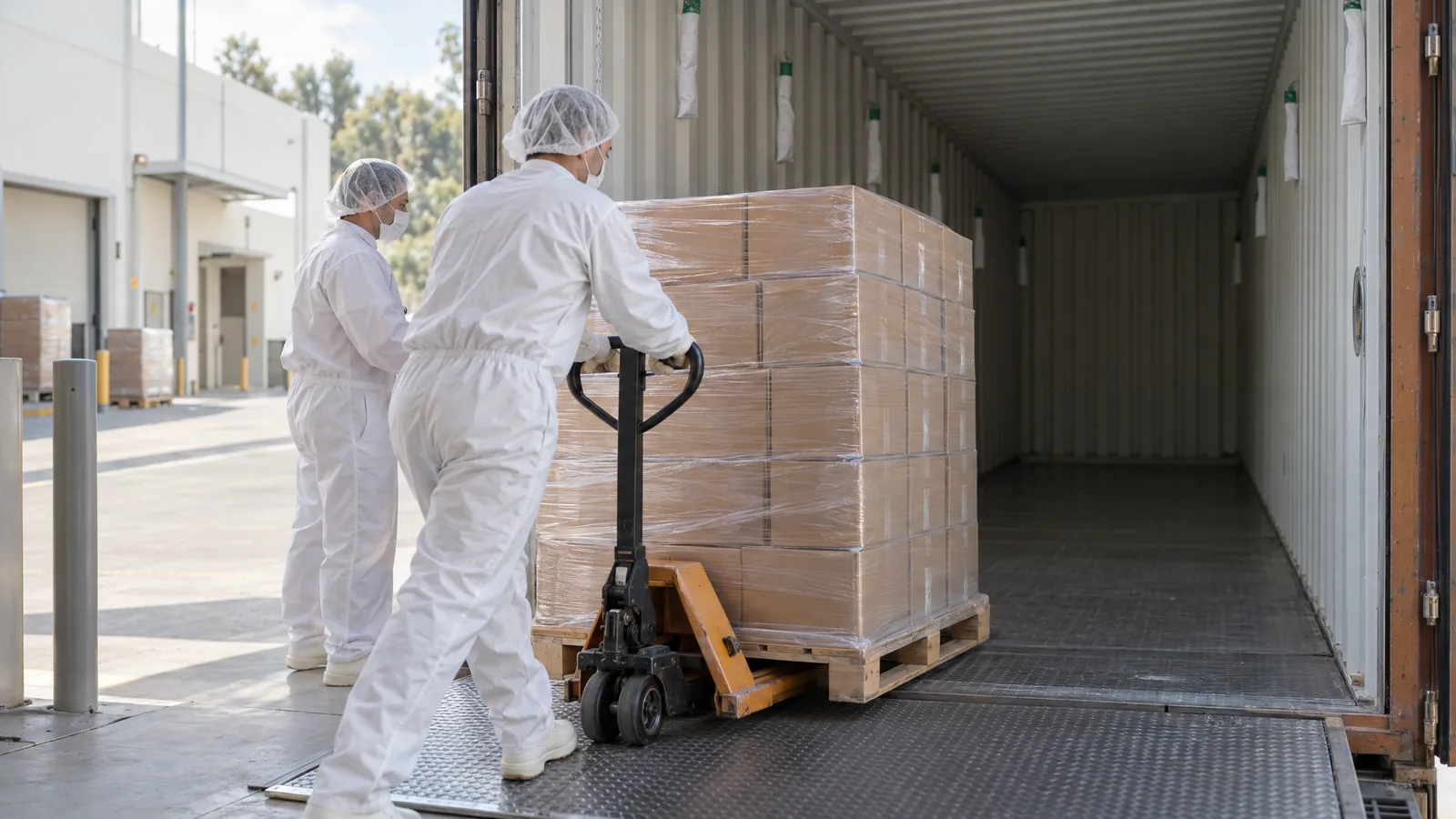
Export cartons should be rated for stacking, not just for the weight inside. Ask for carton dimensions and gross weight early, because they determine how many cartons fit per pallet and per container. Wooden pallets used in international trade must meet ISPM 15 (heat treated and stamped), or you can use plastic or paper pallets instead. Stretch-wrap, corner boards and clear shipping marks (product code, lot number, carton count) keep pallets stable and speed up inspection.
Heat and condensation
Container rain is the classic risk on long ocean routes. Warm, humid air inside the box condenses on the cold steel roof as temperatures swing, then drips onto the cargo. Common precautions include desiccant bags or strips hung on the container walls, kraft paper or container liners over the top tier, and not stuffing cartons in rain or onto a damp floor. None of this replaces good inner packaging; it just stops the outer cartons from collapsing or staining.
Pet Food Export Documents: The Checklist
Most delays in shipping dog treats from China come from documents, not the product. The set below is typical for pet food export documents leaving China, but requirements vary by destination, product type and ingredient. Use it as a starting list and confirm the final version with your customs broker and the official authority in your market.
| Document | Issued by | What it does |
|---|---|---|
| Commercial invoice | Seller | States value, Incoterm, HS code, quantities; basis for duty assessment |
| Packing list | Seller | Carton count, net and gross weights, dimensions, lot numbers per carton |
| Bill of lading (or sea waybill) | Carrier or forwarder | Contract of carriage and, for an original B/L, the document of title used to release cargo |
| Certificate of origin | Authorized Chinese issuing body | Proves Chinese origin; some markets need a specific form to claim reduced tariffs |
| Veterinary health certificate | China Customs (GACC) | Official export health certificate for animal-origin products, where the destination requires one, with wording agreed between the two countries |
| COA and test reports | Factory lab and/or third-party lab | Moisture, protein, fat and microbiological results for the lot; third-party tests on request |
| Import permit or registration | Destination authority, applied for by the importer | Required in some markets before shipment, for example certain animal-origin products into the US |
The export health certificate deserves extra attention. Its wording must match what the destination country has agreed with China, and it is issued only for registered facilities. Our plant holds China Customs (GACC) export registration No. 4266PF0157 for dried pet treats; you can see the English translation on our quality page. Ask your supplier for a draft of every document before the vessel sails, and check names, addresses, HS codes and weights against your import filing.
Shipping Dog Treats from China in 6 Steps
Here is the sequence most importers follow.
- Confirm specs, packaging and the Incoterm. Agree recipe, pack sizes, carton specs, the named port and whether the quote is FOB Qingdao or CIF. Ask your broker which documents your market needs before you sign.
- Approve samples and artwork. Sampling usually takes 2–3 weeks. Production cannot start until the printed packaging artwork is final, and printers have their own lead times and print minimums.
- Production and pre-shipment checks. Mass production runs about 30–45 days after artwork approval. Each lot is tested in-house at SAGEIC; third-party testing by SGS or Intertek can be arranged on request. You can see how the line and lab work on our factory page.
- Book space and load. Under FOB, your forwarder books the vessel and gives the factory a cut-off date. Under CIF, the factory books it. Loading photos and seal numbers should come to you the same day.
- Export inspection and customs clearance in Qingdao. China Customs inspects and issues the health certificate where required, and the export declaration is filed. The factory handles this step under both FOB and CIF.
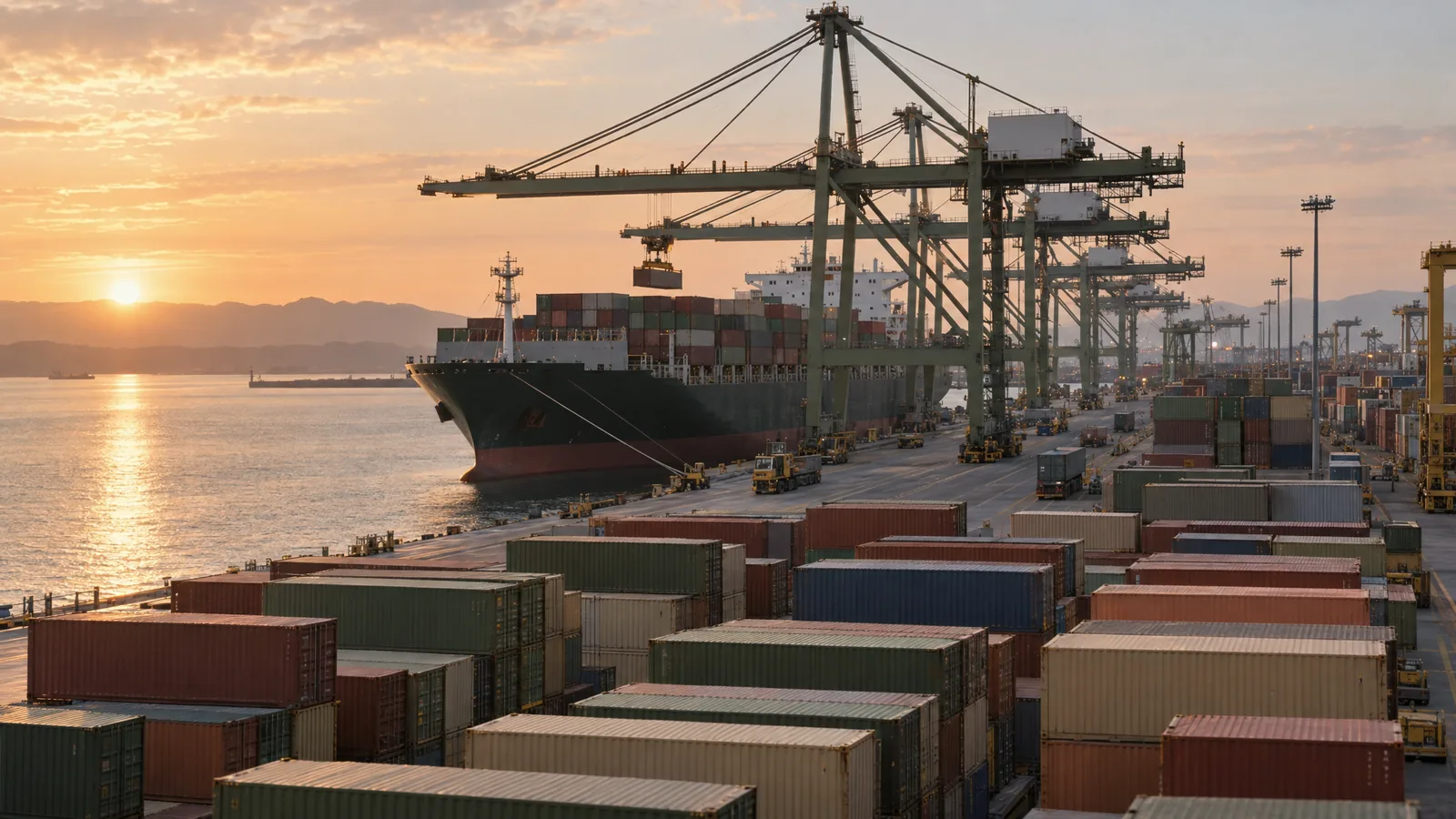
- Transit and destination clearance. Your broker files the import entry and any advance notices, and the goods are released after review. Transit times depend heavily on the route, carrier and season, so ask your forwarder for current schedules rather than planning on averages.
Destination-Side Steps: US and Other Markets
For the US, every food shipment, pet treats included, needs FDA Prior Notice before arrival; for ocean freight, it must be submitted no less than 8 hours before the vessel arrives. The US importer also needs a working FSVP, and poultry-origin treats from China usually fall under USDA APHIS conditions. We cover all of this in our guide to importing dog treats into the US.
Other markets have their own systems. The EU, UK, Japan, South Korea and Southeast Asian countries each set rules on approved establishments, certificate wording, labeling and permitted ingredients, and these change with animal disease outbreaks. Check the official authority’s current requirements and work with a local customs broker who regularly clears pet food. A supplier can provide the factory-side documents, but it cannot guarantee clearance in your market.
Common mistakes that hold shipments
- The consignee or importer name on the health certificate does not match the import filing.
- HS codes or product descriptions differ between invoice, packing list and certificate.
- The importer applied for a required permit too late, after the goods had already sailed.
- Weights on the bill of lading do not match the packing list.
FAQ
FOB vs CIF: which is better for importing dog treats?
FOB is usually better if you have a freight forwarder and want control over routing, carriers and insurance. CIF suits buyers who want one price to the destination port and less admin. In both cases, risk passes to you once the goods are on board in China, so check the insurance cover either way.
Does CIF mean the supplier is responsible if goods are damaged at sea?
No. Under CIF, risk transfers to the buyer when the goods are loaded on board at the origin port, the same as FOB. The seller buys the insurance, but you are the one who claims on it. CIF only requires minimum cover, so ask for broader cover if your cargo value justifies it.
Can I buy dog treats from China on DDP terms?
It is possible but rarely practical. Under DDP, the seller must clear imports and pay duties in your country, acting as importer of record. For pet food, the importer often has its own legal obligations, such as FSVP in the US, so most factories quote FOB or CIF and leave import clearance to the buyer’s broker.
What is an export health certificate for pet treats?
An export health certificate is an official veterinary document issued by China Customs (GACC) confirming that an animal-origin product meets the destination’s agreed conditions. Not every market requires one, and the wording differs by country. Your importer or broker should confirm the exact certificate and any import permit before production starts.
Should I ship my first dog treat order LCL or FCL?
LCL is usually right for a first order or a market test, because you pay only for the space you use. Move to FCL once your volume fills most of a container or you ship regularly. FCL is sealed at origin, which means less handling and lower risk of odor or moisture damage.
How long does it take to get dog treats shipped from China?
Plan on 2–3 weeks for samples and about 30–45 days of production after artwork approval, plus booking, export clearance, ocean transit and import clearance. Transit varies widely by route and season, so ask your forwarder for current sailing schedules. Late artwork and late import permits cause most delays.
How do I keep dried treats from getting moldy in a container?
Start with sealed inner packaging, ideally nitrogen flushed with an oxygen absorber, and keep moisture content in spec before packing. Then protect the container: dry floor, desiccants on the walls, paper or liners over the top layer, and no loading in rain. Condensation, not the treats themselves, causes most transit damage.
Shipping dog treats from China is predictable once the Incoterm, documents and destination steps are agreed before production. For private-label projects, see our OEM/ODM service, or browse more buyer questions on our FAQ page.
Need an FOB Qingdao or CIF quote?
Send us your product list, pack sizes, estimated volume and destination port. We’ll quote FOB Qingdao or CIF, suggest LCL or FCL, and share the export documents your broker will need to review.